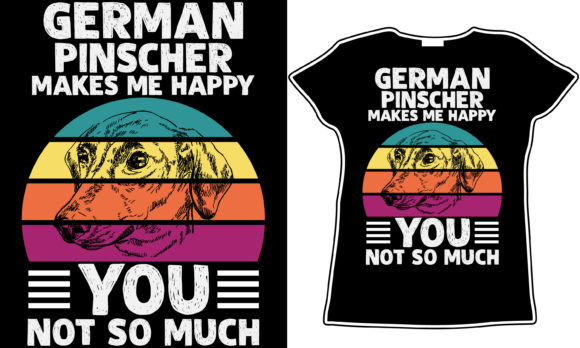
German Pinscher Dog Lover T-shirt
A Designer’s First Look: Clean, Confident, and Craft-Ready
When I opened the German Pinscher Dog Lover T-shirt files, my eye went straight to the silhouette — sharp ears, proud stance, that unmistakable lean musculature. No fluff, no clutter. Just a strong, stylized vector portrait with intentional negative space and balanced weight distribution. It doesn’t shout; it commands quiet attention. That’s rare in dog-themed designs, where cuteness or caricature often overshadows breed authenticity. As someone who’s digitized hundreds of animal motifs for embroidery, I immediately sensed this one was built for translation — not just as a graphic, but as a stitchable idea.
This Isn’t Just a T-Shirt Design — It’s a Versatile Embroidery Asset
Last week, I used the German Pinscher Dog Lover T-shirt to embroider a medium-weight cotton tote for a local breeder’s booth at a dog show. We stitched it on the front panel, centered, using a 4” hoop and lightweight tear-away stabilizer. The result? Crisp satin-stitched outlines, clean fill areas without thread piling, and zero distortion across the fabric’s slight weave. That tells me this design holds up beautifully for custom apparel, embroidered patch conversion, and even apron or kitchen towel applications where clarity matters more than flash.
I also tested it on a soft fleece-lined baby sweatshirt — a common request from Etsy sellers offering personalized nursery decor. The design scaled down smoothly to 3.25” wide without losing definition in the muzzle or ear detail. No tiny floating stitches. No jagged edges. That’s huge for baby embroidery or holiday embroidery like Christmas stockings or Easter pillow covers. It reads clearly at small sizes, which means your handmade product won’t look amateurish under close inspection.
Where This Design Shines — And Where You’ll Want to Pause
The German Pinscher Dog Lover T-shirt excels on stable, medium-to-heavy fabrics: canvas totes, twill caps, denim jackets, linen tea towels, and structured aprons. Its bold lines and generous spacing between elements make it forgiving on textured fabrics and ideal for commercial embroidery workflows where consistency across dozens of units is non-negotiable.
That said — don’t rush it onto stretchy fabric like jersey knits without testing. The design’s confident proportions rely on minimal distortion, so always pair it with cut-away stabilizer and a walking foot if sewing directly onto t-shirts. Also, avoid placing it near curved seams (like cap crowns) unless you’ve confirmed hoop clearance and fabric tension first. The ears and tail tips are well-defined, but tight curves can pull delicate satin-stitch transitions out of alignment.
On dark fabric, the design gains instant gravitas — especially when stitched in charcoal grey or deep burgundy thread. But be mindful of the lettering: while legible, the “Lover” text is part of the overall composition, not a standalone font file. If you plan to edit or resize it independently, open the SVG or EPS first — those vector formats give you full control without pixelation.
What This Design Does for Your Brand — and Your Buyers
As a craft business owner or Etsy seller, you’re not just selling stitches — you’re selling recognition, pride, and connection. The German Pinscher Dog Lover T-shirt delivers that instantly. It doesn’t look generic or AI-generated. It looks *designed* — intentional, respectful of the breed, and visually cohesive enough to stand alone on a boutique shelf or Instagram feed. Customers notice that. They trust it. They tag friends. They reorder.
For personalized gifts, it adds warmth without sentimentality — perfect for groomsmen gifts, breeder appreciation bundles, or German Pinscher rescue fundraisers. And because it’s delivered as clean vector assets (EPS, SVG, and high-res PNG), you can easily adapt it into printable mockups, social media banners, or even sublimation-ready layouts — expanding your digital embroidery file into a broader suite of design assets.
Practical Notes Every Embroidery Designer Should Check
- Test on scrap fabric first — especially if using it for sweatshirt embroidery or layered garments like hoodies.
- Review stitch density in your embroidery software. Dense fills may need adjusted underlay on plush fabrics.
- Confirm hoop size compatibility. While the vector scales freely, your machine’s maximum hoop area sets real-world limits.
- Inspect small details — like the inner ear contour or collar line — before finalizing for tiny lettering or decorative accents.
- Try black-and-white mockups to gauge contrast on light vs. dark backgrounds. This design relies on shape over shading, so it translates cleanly.
- Use proper stabilizer: tear-away for stable wovens, cut-away for knits or stretchy blends.
- Verify licensing before selling finished items or reselling the digital file — especially if listing on marketplaces like Etsy or Creative Market.
Final Thought: A Quietly Powerful Addition to Your Toolkit
The German Pinscher Dog Lover T-shirt isn’t flashy — and that’s its strength. In a sea of overworked, overly detailed, or trend-chasing T-Shirt Designs, it offers restraint, accuracy, and quiet confidence. It works for small shop product launches, craft fair booths, and personalized gift lines alike — because it respects both the craft and the customer. Whether you’re stitching it onto a holiday blanket, a breeder’s cap, or a custom apron for a dog-friendly café, it lands with authenticity. That kind of reliability? That’s what turns one-time buyers into repeat clients — and turns a simple Graphics file into a long-term brand asset.