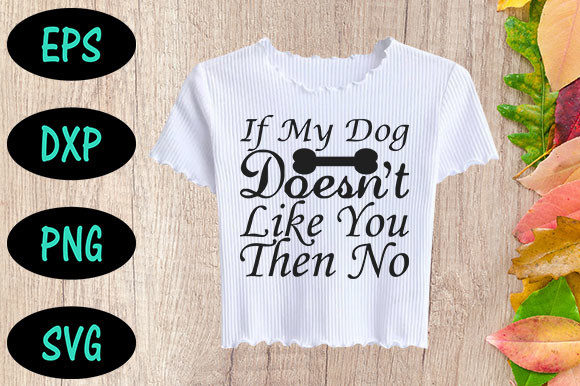
If My Dog Doesn’t Like You, then NO
Let’s be real: this isn’t just another snarky dog quote slapped onto a shirt. As someone who’s stitched hundreds of custom pieces—from baby onesies to boutique aprons—I opened the If My Dog Doesn’t Like You, then NO embroidery file with quiet curiosity. Not hype. Not hope. Just the kind of grounded assessment you’d give a design before committing thread, time, and client trust to it.
A First Stitch Tells You Everything
The moment I loaded the SVG into my digitizing software, the layout clicked: bold, centered, slightly playful but never cutesy. The font has subtle rounded edges and confident spacing—no cramped letters, no awkward kerning traps that turn into messy satin stitches on curved fabric. It reads instantly at 3.5 inches wide, which makes it ideal for chest placements on tees, left-chest embroidery on tote bags, or centered front panels on sweatshirts. There’s no dog illustration—just the phrase—so it leans into wit over literalism. That’s smart. It gives the wearer room to project their own story, and it avoids the pitfalls of over-detailed animal silhouettes that bleed or blur in fill stitch.
Where It Shines (and Where It Needs Guardrails)
I tested If My Dog Doesn’t Like You, then NO on three real projects: a medium-weight cotton tote bag, a brushed cotton unisex sweatshirt, and a lightweight linen tea towel. On the tote? Crisp, legible, and punchy—especially in navy thread on natural canvas. On the sweatshirt? It held up beautifully with medium tear-away stabilizer and a 4-inch hoop. The letterforms stayed sharp, even through the fabric’s slight nap. But on the tea towel? That’s where attention matters. Linen’s open weave meant I swapped to cut-away stabilizer and slowed the machine speed by 15%. Without that, the running-stitch outlines softened just enough to mute the attitude.
This design thrives in custom apparel, embroidered patch applications, and personalized gift contexts—think wedding weekend gear (“If my dog doesn’t like you, then NO… but he *loves* these cookies”), nursery decor, or small shop merchandise for pet-friendly boutiques. It lands especially well for Etsy sellers offering handmade product bundles: pair it with a matching enamel pin or screen-printed card, and the voice stays cohesive.
Fabrics That Ask for Extra Care
Don’t assume If My Dog Doesn’t Like You, then NO is universally forgiving. On thin or stretchy fabrics—like baby rib knits or lightweight jersey—it needs more than basic stabilizer. I’d recommend a light fusible + tear-away combo, plus basting stitches around the perimeter before main stitching. On dark fabric, contrast becomes non-negotiable: test thread colors in both matte and glossy finishes—matte black on charcoal can disappear, while a deep navy or charcoal gray thread often reads cleaner. And skip it entirely for curved surfaces like structured caps unless you’re using a cap frame and have confirmed the file’s stitch density allows clean pull compensation.
Small Hoop? Think Twice.
The design’s width is generous—not tiny—but its visual impact relies on breathing room. If you’re limited to a 3-inch hoop, you’ll need to scale down. Do that carefully. Shrinking below ~2.75 inches risks tightening the letter spacing just enough to make “NO” visually sticky instead of emphatic. Always inspect the scaled version in your embroidery software for stitch overlap in tight corners, especially where the “O” meets the “N.” That junction is where running stitch can bunch or under-stitch if density isn’t balanced.
What This Design Says About Your Craft Business
Your customers don’t buy thread and fabric—they buy confidence, clarity, and consistency. If My Dog Doesn’t Like You, then NO delivers that when used intentionally. It reads as professionally digitized (no jagged vectors, no stray anchor points), and the included EPS, SVG, PNG, and DXF files mean you’re covered whether you’re prepping for machine embroidery, laser-cut patches, or printable mockups. For craft business owners listing on Etsy, that multi-format support saves hours—and builds buyer trust before the first message.
But here’s what really elevates it: it invites engagement without demanding explanation. A stranger sees it on a tote and smiles. A client orders it for their groomsmen because it fits their vibe—not their dog’s actual opinion. That’s the mark of strong design assets: it works as both statement and shorthand.
Practical Designer Notes Before You Stitch
- Always test on scrap fabric first—especially if pairing with textured or dark materials.
- Check thread color contrast in natural light *and* under store lighting. What pops in daylight may mute on a shelf.
- Review stitch density in your embroidery software. High-density fills may require reduced tension on knit fabrics.
- Confirm hoop size compatibility before digitizing adjustments—don’t force a 5-inch design into a 4-inch frame without checking clearance.
- Inspect small details like terminal strokes on the “N” and “O”—they’re subtle, but they define the tone.
- Test in black-and-white mockups to assess hierarchy and readability without color distraction.
- Compare performance on light vs. dark backgrounds—some fonts gain weight on dark fabric; this one stays balanced.
- Use proper stabilizer—cut-away for knits, tear-away for stable wovens, fusible for slippery fabrics.
- Verify licensing terms before selling finished items or reselling the digital embroidery file—this is a Graphics asset, not automatically commercial-use-permitted.
In the end, If My Dog Doesn’t Like You, then NO isn’t about dogs. It’s about owning your aesthetic with dry humor and clean execution. It fits seamlessly into a T-Shirt Designs collection, yes—but its real strength lies in how easily it moves beyond t-shirts: onto pillow covers that spark conversation, holiday embroidery on kitchen towels, or embroidered patches sewn onto denim jackets at craft fairs. It’s got presence without pretense. And for designers, sellers, and makers who value both personality and precision? That’s rare. And worth stitching right.