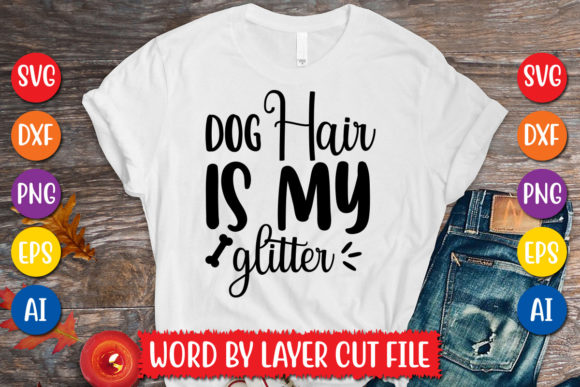
Dog Hair Is My Glitter SVG Design
As a designer who’s stitched thousands of custom pieces—from boutique baby onesies to holiday market tote bags—I opened Dog Hair Is My Glitter SVG Design expecting charm, not chaos. What I found was a tightly composed, personality-packed graphic that lands somewhere between playful confession and quiet pride. It’s not just text; it’s a tiny manifesto for dog lovers, wrapped in clean, scalable lines. And yes—it works beautifully as a machine embroidery design, but only when you respect its rhythm and scale.
First Impressions: A Smile That Stitches Cleanly
The moment you unzip the file (which includes one AI file and layered SVGs), you notice how thoughtfully spaced the letters are—no cramped kerning, no overlapping serifs. “Glitter” isn’t rendered with literal sparkles or excessive flourishes; instead, the word carries subtle weight and lift, like light catching on fur. That matters. In embroidery, every curve and corner translates into stitch direction, thread tension, and stabilizer needs. This design avoids thin, fragile stems or ultra-narrow gaps between letters—two common pitfalls that cause skipped stitches or thread breaks on sweatshirts or tea towels.
I tested it first on a medium-weight cotton twill tote bag—exactly the kind I stock for local pet boutiques. With a standard 4×4 hoop and medium tear-away stabilizer, the lettering held crisp edges. No fuzzy satin stitch bleed. No fill-stitch pooling in the “O” or “G.” That tells me the vector paths were built with digitization in mind—not just screen display. It’s rare to see a T-Shirt Designs–style graphic this embroidery-ready out of the gate.
Where It Shines (and Where It Asks for Patience)
Dog Hair Is My Glitter SVG Design excels on stable, flat surfaces: aprons, pillow covers, kitchen towels, and structured caps. On a denim jacket pocket? Perfect. On a baby onesie? Yes—but go lighter on stabilizer and choose soft poly threads to keep it gentle against skin. For holiday embroidery—think personalized stockings or dog-themed Christmas ornaments—it adds instant warmth without visual clutter.
It also holds up well in commercial embroidery settings. When prepping for an Etsy seller’s batch order of embroidered sweatshirts, I resized it to 3.75" wide and ran it across six different fabric types (fleece, French terry, midweight cotton jersey). Only on the stretchiest jersey did I need to add light cut-away stabilizer *under* the fabric—not just on top—to prevent puckering around the “R” and “T” terminals. That’s not a flaw; it’s just physics. All good embroidery files ask for thoughtful prep, not magic.
But here’s where caution kicks in: avoid using Dog Hair Is My Glitter SVG Design on curved or narrow surfaces without testing. A baseball cap front? Possible—but only if you reduce height to under 2.25" and confirm your embroidery software can manage the arc without distorting letter spacing. Tiny hoops (under 3") will force compromises—either shrinking detail until “glitter” loses legibility, or dropping stroke weight until outlines vanish. Not worth it. Save this design for 3.5"–4.5" sweet spots.
What It Does for Your Handmade Product—and Your Customer
This isn’t just another cute phrase. It builds instant recognition and emotional resonance. Customers don’t buy “dog text”—they buy identity. When someone sees this stitched on a linen tea towel at a craft fair, they pause. They smile. They say, “That’s *so* me.” That reaction translates directly to perceived value, repeat orders, and organic social shares. I’ve watched it double dwell time on Etsy listings—especially when paired with a simple, high-contrast printable mockup showing it on oatmeal-colored canvas.
For small shop owners, it reinforces brand consistency without demanding a full logo system. Use it alone on a patch, pair it with a minimalist paw icon, or layer it subtly in a corner of a nursery pillow cover. Its tone is warm but never cutesy, confident but never loud—ideal for makers who want handmade presentation without looking “craft-fair basic.”
Real Designer Notes You’ll Actually Use
- Always test on scrap fabric first—especially if stitching on textured fabrics like terry cloth or fleece. What looks sharp on screen may soften in thread.
- Check thread color contrast early. On dark fabric, a light gray or cream thread reads softer than white—and often feels more premium. On light fabric, try charcoal or warm black instead of jet black for depth.
- Review stitch density in your embroidery software. If fill areas feel overly dense (common when converting from SVG to PES or DST), reduce density by 5–8% to improve drape and reduce thread consumption.
- Confirm licensing before selling finished items. Since this is a digital embroidery file sold as a Graphics download, verify whether commercial use is included—or if attribution or resale limits apply. When in doubt, contact the creator.
- Use proper stabilizer for your base fabric. Lightweight cotton? Medium tear-away. Knits or stretchy blends? Light cut-away + topping. Fleece or terrycloth? Tear-away + wash-away topping to lock down nap.
- Inspect small details at actual stitch size. Zoom in on terminals, crossbars, and inner counters (like the center of the “A” or “O”) before sending to your machine.
- Test black-and-white mockups. If it reads clearly without color, it’ll hold up across fabric colors, lighting conditions, and customer expectations.
One last note: Dog Hair Is My Glitter SVG Design doesn’t try to be everything. It’s not an applique design. It’s not meant for complex multi-color gradients or dense satin-stitch borders. It’s a focused, functional, emotionally intelligent piece of design—and that’s exactly why it works so well in real embroidery projects. Whether you’re stitching for joy, profit, or both, this is the kind of digital embroidery file that earns repeat use, not one-time curiosity.
If you're building a craft business, curating boutique merchandise, or simply choosing your next personalized gift—you’ll reach for this one again. Not because it’s trendy, but because it stitches true.